When most people hear the words cerebral palsy awareness, I imagine their minds go immediately to the medical explanation: brain injury, muscle coordination, mobility challenges, therapy, wheelchairs.
And yes, all of those things can be part of the picture.
But they are not the whole picture.
The CDC describes cerebral palsy as a group of disorders affecting movement, balance, and posture, and notes that it is the most common motor disability in childhood. Yet knowing that definition tells you surprisingly little about the person sitting beside you in class, rolling past you at the grocery store, applying for a job, laughing with friends, falling in love, writing a book, wrestling with faith, or simply trying to get through an ordinary Tuesday.
That is where real awareness begins.
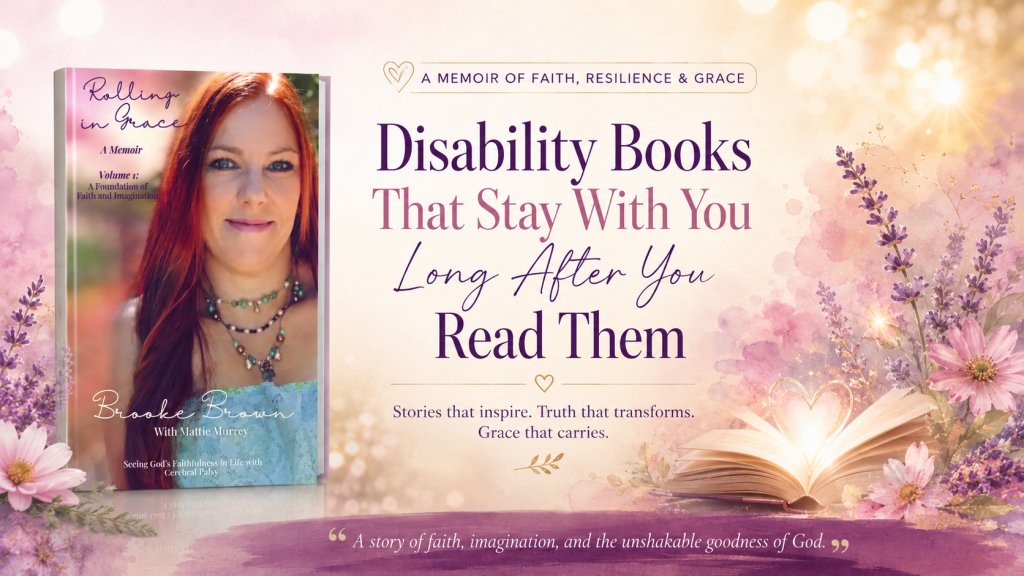
In Rolling in Grace: Volume 1—A Foundation of Faith and Imagination, I share my experience of living with cerebral palsy, but I never intend my story to speak for everyone with CP. No two people have exactly the same body, abilities, challenges, personality, faith, family, dreams, or story.
Maybe that is the first lesson of awareness: see the person before you decide you understand the disability.
What Cerebral Palsy Awareness Really Means
Awareness is useful, but understanding asks something more from us.
You can know what cerebral palsy means medically and still make incorrect assumptions about someone who has it. You can recognize a wheelchair and still fail to recognize the person using it. You can understand that someone has a speech impairment and still make the very wrong leap that speech difficulty equals intellectual disability.
Real disability awareness requires curiosity without intrusion, respect without pity, and enough humility to admit, I don’t know this person yet.
Cerebral palsy exists across a wide range of experiences. Some people walk independently. Some use walkers or wheelchairs. Some communicate verbally, while others use augmentative and alternative communication. Some need considerable daily assistance; others live highly independent lives.
The diagnosis may tell you something about a person’s body. It does not tell you everything about their mind, character, abilities, or future.
A Wheelchair Does Not Define a Person’s Potential
I use a power wheelchair.
Notice the wording there: I use it.
My wheelchair is not my identity. It is a tool that gives me mobility and allows me to move through a world that was not always designed with bodies like mine in mind. In my memoir, I describe reminding myself that I am not bound by my chair; I use it to move through the world.
That distinction matters.
People sometimes look at mobility equipment and see dependence. The person using it may see freedom.
Independence does not have to mean performing every physical task without assistance. Sometimes independence means choosing what happens in your own life, directing your own support, pursuing education, developing friendships, working, creating, advocating, worshiping, traveling, or deciding what dreams are worth chasing.
Different does not automatically mean less.
Speech Differences Should Never Be Mistaken for Intelligence
This one is personal.
I have dysarthria, which affects the physical production of my speech. Throughout my life, people have heard my voice and assumed I could not understand them. Some have spoken around me rather than to me. Others have talked unnecessarily loudly or slowly. In group conversations, people sometimes move along before I have been given enough time to contribute.
And then there is one of my least favorite social experiences: someone does not understand what I said, but smiles and nods anyway.
Please don’t.
Really.
Asking me to repeat myself does not offend me. Pretending I said something understandable when you have absolutely no clue what came out of my mouth is far more frustrating.
One of my childhood friends understood this beautifully. If he missed something I said, he made the effort to figure it out. That simple willingness communicated something powerful: what I had to say was worth hearing.
Communication may require patience. Patience is not charity.
It is respect.
Why “Assume Competence” Matters
One of the phrases that has become especially meaningful around my story is assume competence.
It means beginning an interaction from a position of respect rather than automatically lowering expectations because somebody looks, moves, speaks, learns, or communicates differently.
An endorsement for Rolling in Grace specifically describes the lesson of looking past superficial judgments and assuming competence.
That principle matters everywhere.
It matters when a teacher decides how much a student can learn. It matters during a job interview. It matters when adults speak to a disabled child. It matters in friendships, churches, medical offices, stores, workplaces, and family decisions.
A person’s visible disability does not establish their intellectual ability.
Begin with dignity. Then learn who the individual actually is.
Cerebral Palsy Awareness in Schools
School inclusion is about far more than placing a child with a disability inside a general classroom and congratulating ourselves for being inclusive.
I spent part of my childhood balancing ordinary school life with speech therapy, physical therapy, occupational therapy, and adaptive PE. Sometimes therapy meant missing recess—the very time when friendships were forming and other children were simply being children.
Teachers mattered enormously, too.
I remember educators who recognized my abilities and helped them grow. I also remember teachers who treated accommodations and therapy appointments as inconveniences. During fifth grade, one teacher criticized work affected by my fine-motor limitations despite having been informed about those limitations and my accommodations.
Inclusion requires more than physical presence.
It requires expectations that recognize ability, accommodations that are actually honored, opportunities for friendship, and educators willing to ask, What does this student need to participate meaningfully?
Parents as Advocates Without Limiting Their Children
My parents have always been among my strongest advocates. My memoir is dedicated in part to them because they continued seeing my capabilities when other people tried placing me inside what I call the “disability box.”
Parents of children with disabilities often have to become remarkably skilled advocates. IEP meetings, therapies, specialists, accessibility, insurance, school decisions—there is a lot to navigate.
But advocacy also evolves.
As children grow, they need opportunities to develop preferences, make decisions, take appropriate risks, discover interests, and eventually advocate for themselves.
I learned this through experiences when my own opinion about school decisions mattered more than adults initially realized. Sometimes parents absolutely do know best. Sometimes the child is noticing something adults have missed.
Listening is part of advocacy too.
Cerebral Palsy, Friendship and Social Inclusion
People occasionally avoid someone with a visible disability because they are afraid of doing something wrong.
I understand the awkwardness.
But avoiding somebody entirely because you might feel awkward does not exactly solve the problem.
Friendship has never required perfect communication. It requires effort.
Some of the most meaningful friendships in my life developed because people pushed beyond that initial uncertainty and simply got to know me. We discovered shared interests, laughed at ridiculous things, talked about faith, writing, movies, relationships, frustrations, and ordinary life.
Those relationships were not acts of kindness performed for the disabled girl.
They were friendships.
That difference matters.
From Awareness to Action: Challenging Ableism
Ableism often begins with an assumption about what a disabled person supposedly cannot do or what their life must be like.
Sometimes it sounds negative: helpless, incapable, dependent.
Oddly enough, it can also arrive disguised as praise.
I discuss the difference in Rolling in Grace between genuine inspiration and what disability advocates have called “inspiration porn”—turning ordinary activities performed by disabled people into motivational material primarily for nondisabled audiences.
Disabled people absolutely can inspire others. I hope my life encourages people.
But there is a difference between being moved by someone’s character, faith, perseverance, creativity, or accomplishments and being amazed simply because a disabled person went to school, attended prom, worked, exercised, got married, or bought groceries.
Sometimes we’re inspirational.
Sometimes we’re just buying groceries.
Why First-Person Stories Matter for Cerebral Palsy Awareness
Medical information teaches us what cerebral palsy is.
Stories reveal what living with cerebral palsy can feel like.
That is why I believe memoirs, conversations, classroom presentations, disability advocates, and first-person accounts matter so much. Students and future teachers or therapists can learn disability etiquette from textbooks, but hearing lived experiences introduces something a definition cannot provide.
Stories reveal frustrations and friendships. They reveal pain, ridiculous situations, dreams, faith, loneliness, ambition, humor, love, and everything else that stubbornly refuses to fit inside a diagnostic label.
They remind us that disability is part of a person’s story without necessarily being the entire story.
Rolling in Grace and a More Human Understanding of Cerebral Palsy
Rolling in Grace: Volume 1—A Foundation of Faith and Imagination grew from my desire to tell the truth about my experience—faith and doubts, limitations and possibilities, education, relationships, imagination, disability, pain, perseverance, and the strange twists life has taken along the way.
The Wheels2Wings website describes the memoir as Brooke Brown’s journey through cerebral palsy, faith, imagination, school, sports, friendship, love, and the misconceptions she has encountered.
But I hope readers come away with more than information about me.
I hope they reconsider the next person whose body or communication looks different from their own.
Cerebral palsy awareness begins with learning what CP is.
It becomes meaningful when that knowledge changes how we treat people.
Listen when someone communicates differently.
Ask rather than assume.
Give people time to answer.
Speak directly to the person instead of around them.
Respect mobility aids as tools.
Make accommodations meaningful rather than performative.
And when you are uncertain about someone’s abilities, assume competence first.
Look beyond the wheelchair. There is always a whole person there.